
The Secrets of our “Pulpo a la Gallega”
A Galician Masterpiece in Washington: The Secrets Behind Our ‘Pulpo a la Gallega’
Hello Alabardero friends. If you have visited our home on I Street NW, just next to the White House and the World Bank, you already know that for us, Spanish gastronomy is much more than food. It is a form of cultural diplomacy. Since 1989, we are bringing the true, timeless soul of Spain to the heart of Washington, D.C., blending our classic dark wood atmosphere with the finest hospitality. Today, I want to take you on a sensory journey to the misty, Atlantic coast of Northwestern Spain to talk about one of the absolute star tapas of our menu, the legendary Pulpo a la Gallega.
The true beauty of this dish lies in its history, which is deeply connected to the old Spanish traditions. Even though the octopus is harvested from the cold and wild waters of the Galician ocean, the recipe was actually perfected inland. During the Middle Ages, the monks of the Monastery of Oseira received large quantities of dried octopus as payment for tithes from coastal fishermen. To enjoy this abundance, the locals learned to hydrate and cook it, and it quickly became the quintessential dish of the traditional countryside livestock fairs, known as the feiras. It is, by definition, a dish born for celebration, community, and sharing with good company.
In high-end Spanish cuisine, we never like to hide a premium product behind heavy sauces, because the secret of a perfect Pulpo a la Gallega relies entirely on the absolute quality of the ingredients and a deep respect for the ritual. First of all, to achieve that legendary texture, tender to the bite but with a distinct firmness, our chefs perform the traditional ritual of asustar al pulpo. This means we dip the octopus three times into boiling water by its tentacles before letting it cook completely.
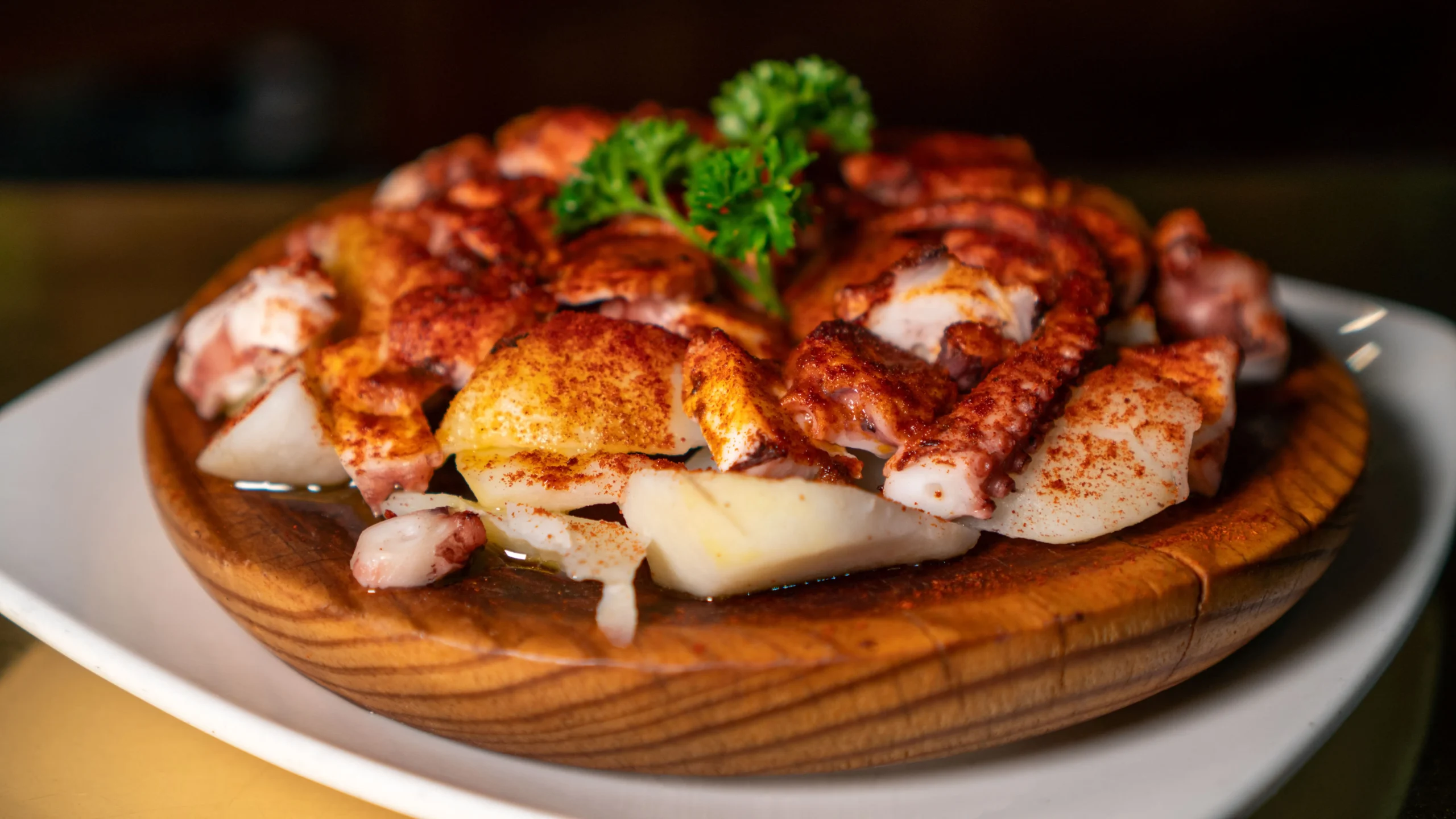
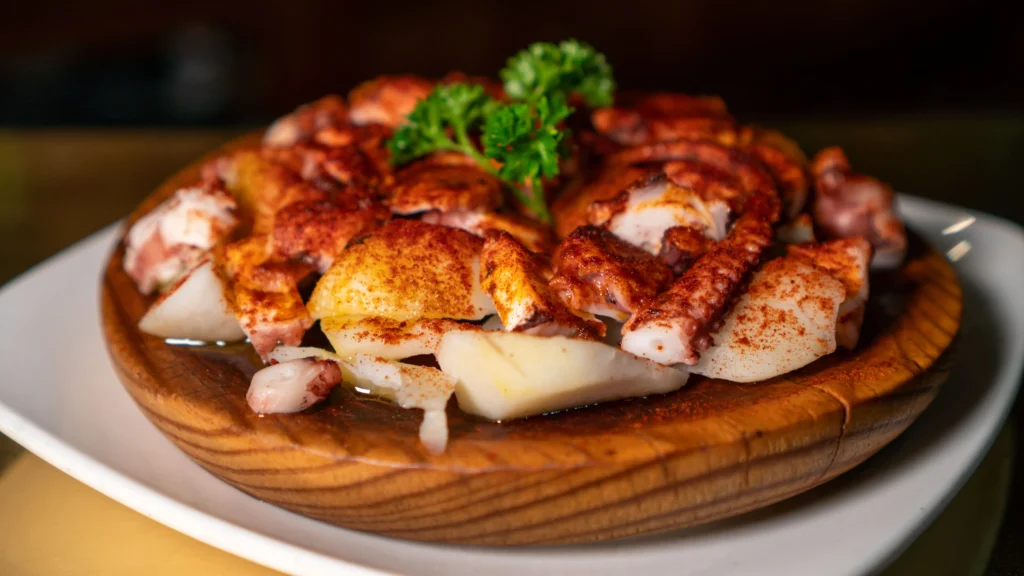
We cook the traditional fairground potatoes, the famous patatas cocidas. This is a beautiful secret because the potatoes absorb the delicate flavor of the sea and take on a gorgeous, signature pink hue. Finally, everything is finished with the holy trinity of Spanish dressing, which consists of a generous drizzle of Spain’s finest extra virgin olive oil, a sprinkle of coarse sea salt flakes, and a dusting of authentic Pimentón de la Vera, the smoked Spanish paprika that combines sweetness with a subtle touch of spicy.
When you order this tapa at Taberna del Alabardero, you will notice it is always served on a traditional, thick wooden plate. This is not just for aesthetics. The wood naturally absorbs the excess cooking water while retaining the olive oil and paprika on top, creating a rich, flavorful emulsion that screams for a piece of our crusty bread.
However, I must be completely honest with you about our methods. While we respect tradition to its core, we do adapt one small detail for our elegant dining room. If you visit a rustic market fair in a village in Galicia, you will see the traditional pulpeiras cutting the hot tentacles in the air using large scissors. It is incredibly fast, and it saves them from needing a cutting board in the middle of a crowded, busy field. Here in D.C., wrapped in our elegant atmosphere with white linen tablecloths, we prefer a touch of refinement. Our culinary team uses a razor sharp chef’s knife on a proper board to create perfectly uniform, elegant slices. The soul of the dish remains untouched, but the presentation matches the sophistication our guests expect from us.
To elevate this experience to the maximum, our sommelier always recommends pairing our Pulpo a la Gallega with a crisp, chilled glass of Albariño from our extensive wine cellar. The bright acidity and saline undertones of this white wine cut through the richness of the olive oil beautifully, preparing your palate for the next bite. Whether you are hosting a high stakes business lunch or enjoying a sophisticated evening with friends, this dish is the perfect way to start your experience.
We look forward to welcoming you at our table very soon. ¡Buen provecho!